Harpies’ Attack at the River
Ronja, the Robber's DaughterHarpies’ Attack at the River is a near-fatal pursuit in which Ronia and Birk are driven from the river toward Greedy Falls, then escape by turning a sudden change in the current into a chance to reach the bank. Its decisive significance lies in the way an external threat tests the siblings’ trust: Ronia briefly fears that Birk has disappeared, but he returns to her, and they face the river’s danger together rather than abandon one another.
Causes and Setting
The attack follows a period of life in the forest in which Ronia and Birk have learned to treat its creatures as inhabitants in their own right, not possessions. Birk had challenged Ronia’s claim to fox cubs and to the woods, reminding her that the forest belonged to foxes, wolves, bears, elk, wild horses, birds, insects, and even creatures such as wild harpies and gray dwarfs. The scene’s danger therefore comes from a world the children share with other living beings, not from a threat that can be settled by asserting ownership.
Their life together had also included the deliberate negotiation of human needs with animal independence. In spring, they sat quietly among the woods’ creatures and accepted that spring was for everyone. Ronia gave up the idea of taking a wild horse away from the forest, though she still wanted to ride. Later, she and Birk rode the horses they had managed to tame, while the injured mare Lia was allowed to return to her herd when she no longer wanted to be milked. Their encounters with animals establish the boundary the attack will sharpen: the forest is a shared home, but its dangers are real, and human beings may be singled out within it.
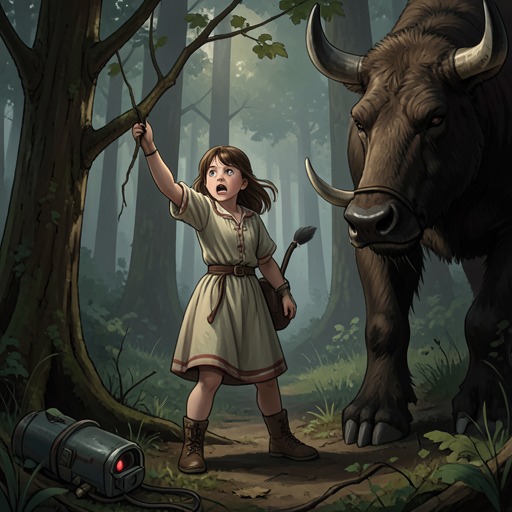
As summer advances, the nights grow darker and Ronia reads the change in the sky as a sign that autumn is approaching. The next morning, after the children have bathed as usual, a large flock of wild harpies gathers above the river. The suddenness of their arrival transforms an ordinary routine into a trap: the children are in the water, exposed, while the attackers control the air above them.
The Attack
The harpies do not immediately strike. They hover, screech, and threaten, prolonging the children’s fear while the great harpy circles above the river and waits to signal the attack. This delay makes the danger a pursuit as well as a physical assault: Ronia and Birk have to endure the threat without knowing when the flock will descend. They dive beneath the water to escape the harpies’ reach, but when they surface and see the sky darkened by more of the flock, they understand that they cannot simply swim away.
Ronia briefly loses sight of Birk. In the confusion she calls for him and fears that he has drowned or left her alone. The moment puts their bond under pressure not because either has chosen to abandon the other, but because the river and the harpies separate them from view. The great harpy swoops toward Ronia while she is still unable to find him; then Birk’s voice reaches her, calling her to come quickly.
Birk is clinging to a fallen birch being carried downstream. Its upper branches still bear green leaves, and he is barely visible above the water. Ronia swims to him before the current can carry him beyond her reach. He pulls her close, and the two shelter as best they can beneath the branches. The birch gives them a temporary refuge from the harpies, but it is also carrying them toward the falls. When Birk asks whether she can hear Greedy Falls, Ronia recognizes that the current has taken them too close to the abyss for escape to seem likely.
The Current and the Escape
The river’s growing force turns the birch from a hiding place into a vehicle of danger. Ronia and Birk know they are being carried toward Greedy Falls; their speed increases as the roar grows, and Ronia feels the current drawing them onward. In that moment, facing the falls together seems preferable to being taken by the harpies. Birk puts an arm around Ronia’s shoulders, and their chosen relationship becomes the emotional anchor of the crisis: whatever happens, they remain sister and brother.
Before they can act, the birch strikes Greedy Hump. The impact swings the branch around and changes its direction, carrying it some distance toward the riverbank before the current can seize it again. The collision creates a narrow opportunity, not safety itself. Birk calls for them to try, pulls Ronia from the branch, and both enter the foaming eddies. They must now swim for themselves against the current, with the smoother water close to the bank still difficult to reach.
Ronia is ready to give up, believing that Greedy Falls will eventually prevail. Birk keeps turning back to look at her as he struggles forward; his repeated attention prompts her to keep trying. She reaches the smoother water, and Birk pulls her the rest of the way toward shore. At the limit of their strength, they haul themselves onto the bank and fall asleep in the sun, unaware that they have survived. Their escape depends on successive acts of mutual aid: Ronia swims to Birk, Birk brings her onto the birch, and then he helps draw her to land.
Aftermath and Significance
The children do not return to Bear’s Cave until the sun is sinking. Lovis is waiting for them on the platform outside, making their arrival a return from a danger that had seemed likely to end in death. The episode resolves with survival, but not through a victory over the harpies: the children escape their reach by taking advantage of the river’s accidental change of direction and then fighting their way to shore.
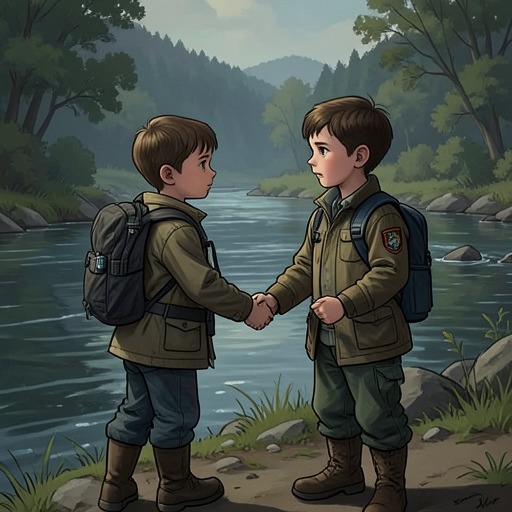
The episode also gives concrete form to the siblings’ promise that nothing can part them. Ronia’s fear that Birk has vanished is answered when she hears his voice; at the river’s edge, his persistence helps her continue when she wants to stop. Their closeness is not merely a statement of affection but a practical means of survival, expressed through searching, calling, reaching, pulling, and refusing to leave the other behind.
Set against the wider story, the attack extends the book’s recurring account of life in the forest as shared rather than human-owned. Ronia and Birk have learned to leave the wild mare with her herd and to sit without disturbing the animals around them; the harpies, however, remain dangerous members of that same world. The river episode therefore holds two truths together: the forest is home to many kinds of life, and sharing it does not make its risks harmless. The children survive not by mastering the wilderness, but by responding to its changing conditions and relying on one another.